

Did you ‘miss the memo’?

If you’re in the first year or two of a doctorate, there is a fair chance you’ve been told to do one or more of the following:
- Find your gap.
- Read the literature.
- Refine your research question.
- Develop your methodology.
Simple, so they make you think. Except you open the database and find 3,742 papers – or maybe four, depending on your search criteria.
Your research question changes every time you read a new paper. How are you supposed to read these things anyway?
Every paper points to another paper.
You had a beautiful spreadsheet set up to keep your PhD records. Now it makes no sense at all.
And somewhere in the back of your mind is the suspicion that everybody else has already worked out how doctoral research works and you’ve somehow missed the induction session where they explained it.
My friend: you haven’t.
I’ve been looking this week at the questions early-stage doctoral researchers are asking publicly online, and the same cluster keeps appearing.
How do I find the research gap?
How do I know what literature I should be reading?
How do I turn a broad idea into a proper research question?
How much of this should I have worked out by now?
Those look like four separate problems, but I don’t think they are.
I think they’re usually one structural problem.
Your doctorate doesn’t begin as a straight line
There’s a lovely fiction about research that goes something like this:
Topic → literature → gap → research question → methodology → data.
Very tidy.
Unfortunately, actual research has rarely received the memo.
You read something and the question shifts.
The changed question sends you towards different literature.
That literature makes you rethink what your contribution might be (assuming you’ve got to the contribution bit yet).
Then your proposed method exposes a problem in the question.
So you go round again.
That isn’t evidence that you’re failing to make progress.
That is the intellectual work.
Research-question development itself is something doctoral researchers learn. It isn’t simply a sentence-writing exercise you ought to arrive knowing how to do. Research on doctoral education has described developing research questions as a core research skill that needs active development and scaffolding.
Which is why I get twitchy when doctoral researchers are simply told to “find a gap.”
Stop hunting for a small empty hole
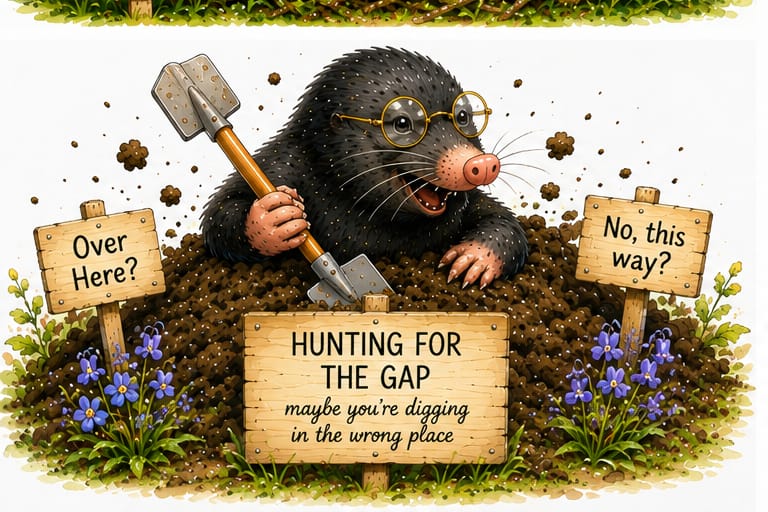
The word gap causes an extraordinary amount of trouble.
It can make researchers imagine the literature as a giant wall with one missing brick.
Your job is apparently to inspect the entire wall until you discover it. That is not a terribly useful way to spend several years.
Instead, I normally ask students:
What are you interested in understanding?
What does the existing literature help us understand already?
Where does that understanding become incomplete, contradictory, limited or context-dependent?
Why does that matter?
And then:
What could you realistically investigate that would move that understanding forward?
Now we have the beginning of a study.
Your contribution doesn’t necessarily have to be “nobody in human history has ever researched this.”
It might come from a different context, population, theoretical interpretation, method, relationship between concepts, professional problem or way of explaining something we only partly understand.
Especially in a professional doctorate, the useful question is often not simply what hasn’t academia studied?
It is also:
Where is professional practice telling us that our existing understanding isn’t enough?
That’s a much more interesting place to start.
And please stop trying to read everything
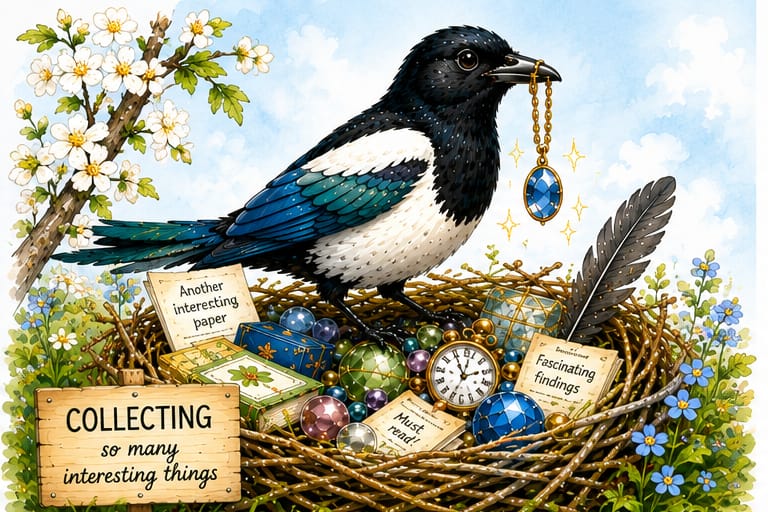
The second theme I’ve seen repeatedly this week is researchers drowning in literature.
They are reading. Saving. Highlighting. Categorising. Downloading.
Occasionally downloading the same article twice because they can no longer remember what they’ve already got.
And still feeling as though they haven’t done enough.
The problem is that collecting literature and using literature are different activities.
You don’t need a personal copy of the entire academic internet before you’re allowed to have an idea.
Reading becomes useful when it changes or strengthens your thinking.
When I work with doctoral researchers, I keep pulling them back towards questions such as:
- Why am I reading this?
- What does it give me?
- What changes because I’ve read it?
- Where does it sit in the argument I’m building?
If you cannot answer those, another afternoon of downloading PDFs probably isn’t the next move.
This is one reason I teach a Touch It Once approach to doctoral reading: not because every article literally gets opened once, but because every encounter with literature should do some work, so here’s what to do when you read something:
Extract the useful idea. Record why it matters. Connect it to something. Decide what happens next.
Don’t simply put it carefully into an academic cupboard!
Your research question is allowed to wobble
Another researcher I found this week was six months into a doctorate and worrying because supervisors wanted a more curious research question.
They wondered whether changing the wording would fix it.
Perhaps.
But usually the interesting work comes one level earlier.
A research question isn’t good because it sounds doctoral.
It is good because it creates a study that is:
- clear enough to investigate,
- open enough to discover something,
- important enough to matter,
- and small enough to finish.
That last one doesn’t get nearly enough attention.
The doctorate is not your opportunity to solve the entire problem.
It is your opportunity to make one defensible contribution to our understanding of it.
So what should you actually have by the end of this stage?
Not certainty.
I’d be looking for increasing coherence.
Can you explain, in ordinary language:
- What is the broad problem?
- What part of it are you interested in?
- What do we broadly know already?
- What don’t we understand well enough?
- Why does that matter?
- What do you currently think you need to ask?
- What kind of evidence might let you answer it?
Those answers will change. That’s fine.
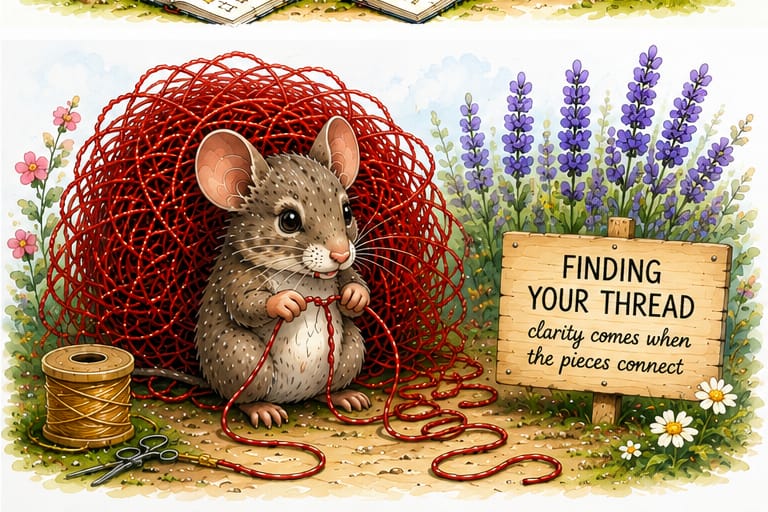
What we’re building is what I call the golden thread: the line of logic that eventually connects the problem, literature, question, methodology, findings and contribution.
In the beginning it may be faint.
Your job isn’t to pretend it’s finished.
Your job is to keep making it clearer.
And if you’re six months or eighteen months into your doctorate thinking,
I have read so much, and somehow I know less than when I began…
you may not actually be lost.
You may simply have reached the point where accumulating knowledge is no longer enough.
Now you have to start organising it into your own argument.
That’s a different skill.
And very often, that’s where the doctorate properly begins.
If any of this resonated, you’ll find a comfortable landing place inside the Doctoral Success Circle. Click here to find out more.






0 Comments